


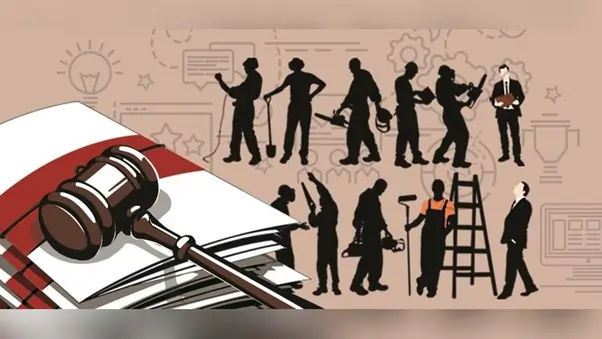
Image Source: Business Standard India’s labour market has been shaped by a complex legacy of well-intentioned but ultimately restrictive regulations. For decades, labour laws designed to protect workers ended up discouraging firms from growing, formalising, or hiring at scale. The sweeping labour reforms implemented through the four labour codes mark an important break from this past. By modernising outdated legislation and simplifying compliance, these reforms promise to reshape the labour landscape and unlock India’s employment and growth potential. From here on, the states that enforce these reforms with full commitment are likely to witness major investments and job creation. The foundation of India’s labour regulation was the Industrial Disputes Act (IDA) of 1947. This created powerful disincentives for firms to expand beyond a small size. Three major distortions emerged. First, productive firms deliberately stayed smaller than optimal, fearing regulatory burdens if they grew. This prevented the development of large, competitive manufacturing enterprises. Second, India became a country of micro and small informal units, which often lacked access to technology, capital, and skilled management. These firms naturally struggled to raise productivity or offer secure, well-paid jobs. Third, the laws ended up protecting a tiny minority of formal, unionised workers, while the vast majority remained outside any legal safety net. Ironically, rules intended to defend workers benefited only those already fortunate enough to be in stable, formal jobs. To close loopholes, the government introduced the Contract Labour Act (CLA) of 1970, increasing compliance requirements for firms hiring contract workers. Amendments in 1976 and 1982 tightened restrictions by lowering the thresholds at which firms needed government permission for layoffs. Despite India’s 1991 economic liberalisation, the labour law system remained largely untouched, continuing to discourage large-scale, labour-intensive manufacturing. Over time, this rigid regulatory environment led to a structural imbalance: India had abundant labour, but firms were reluctant to hire. Job creation lagged behind economic growth, and millions remained in informal employment. Recognising these distortions, the government consolidated 29 laws into four comprehensive labour codes: the Code on Wages (2019), the Industrial Relations Code (2020), the Code on Social Security (2020) and the Occupational Safety, Health and Working Conditions Code (2020). Now notified, these reforms aim to balance worker protection with economic dynamism. They modernise outdated provisions, simplify compliance, expand social protection, and give firms the flexibility they need to grow. Universal wage and social protection: The Code on Wages establishes a uniform national framework for minimum wages and timely payments. This is a major step toward inclusivity. Earlier laws covered only certain categories of workers, excluding many in the informal sector. Now, all workers across industries, regions, and job types receive wage protection. Combined with mandatory appointment letters, this pushes employers toward formalisation and transparency. The Code on Social Security expands the safety net to gig workers, platform workers, and other non-traditional categories that form a rapidly growing share of India’s workforce. For the first time, delivery workers, ride-share drivers, freelance workers, and others on digital platforms are legally recognised and eligible for social security benefits. This modernises labour law to match contemporary forms of work. Simplified compliance and reduced bureaucracy: A major obstacle for Indian firms has historically been the complexity of labour compliance. Different laws required multiple registrations, licences, inspections, and returns. The new codes consolidate these into one registration, one licence, and one return, greatly reducing bureaucratic friction. This is crucial for small and medium enterprises, which often operate informally precisely to avoid compliance burdens. Simplified procedures make it easier and more attractive for firms to join the formal economy, hire workers officially, and expand operations. Flexibility in hiring and managing labour: The Industrial Relations Code introduces greater flexibility in hiring and workforce management. While maintaining protections against arbitrary dismissal, it streamlines processes for layoffs and retrenchment in medium-sized firms. This reduces the uncertainty firms previously faced, encouraging them to hire without fear of crossing rigid thresholds. At the same time, worker protections remain intact through dispute-resolution mechanisms and safeguards against misuse. The goal is not to erode rights but to create a predictable, rules-based environment where both workers and employers benefit. Modern, safer workplaces: The Occupational Safety, Health and Working Conditions Code consolidates safety and health regulations across sectors and establishes clearer standards for working conditions. This is significant in construction, mining, manufacturing, and transportation, where outdated or fragmented laws previously created confusion. A modern safety framework improves the quality of work, encourages investment in safer technology, and ensures dignity and protection for workers. Empirical evidence from recent decades suggests that Indian states that have implemented labour reforms have benefited more from trade liberalisation. This indicates that states with less restrictive labour regulations, such as lower bureaucratic hurdles and greater labour market flexibility, have enabled their industries to better capitalise on trade opportunities. But on the whole, these state-level reforms have been rare. India’s labour market has long been shaped by protective laws that turned into a stranglehold, pulling back its economic potential. The new labour codes represent a comprehensive attempt to correct that historical imbalance. By simplifying regulation, expanding protections, embracing new forms of work, and giving firms the flexibility to grow, these reforms create the conditions for a more dynamic labour market. If implemented effectively, the reforms can promote formal employment, raise productivity, encourage investment, and deliver better working conditions. They offer a pathway for India to move from a fragmented, informal labour system to a more modern, inclusive, and growth-oriented framework, unlocking the true potential of its vast and diverse workforce. Courtesy: The Indian Express
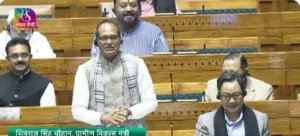
Image Source: AIR Public debate around welfare reform is both necessary and healthy. Concerns expressed in some quarters over the Viksit Bharat-Guarantee for Rozgar and Ajeevika Mission (Gramin) (VB-G RAM G) stem from a legitimate apprehension: Any change to a historic employment guarantee could dilute hard-won worker rights. That concern deserves respect. But it also calls for a careful reading of what the Viksit Bharat G RAM G Bill actually provides, rather than assumptions. The most prominent feature of the Bill is that it gives a legal guarantee of 125 days of wage employment in a year to each rural household. The Bill also provides for an unemployment allowance in case employment is not provided within 15 days of application, by removing MGNREGA-era disentitlement provisions. The weakness of India’s rural employment framework lay not in intent, but in structural shortcomings. VB-G RAM G must be assessed against this reality. Far from weakening entitlements, the proposed framework addresses MGNREGA deficiencies directly. By removing disentitlement provisions that had the effect of denying workers their due, and by strengthening statutory obligations relating to transparency, social audit and grievance redressal, the Bill seeks to restore credibility to the employment guarantee. Enhanced accountability mechanisms and time-bound grievance resolution are not peripheral features; they are central to making the right meaningful on the ground. In this sense, VB-G RAM G does not retreat from social protection. It seeks to convert a frequently frustrated entitlement into a real, enforceable guarantee. The most common criticism is that VB–G RAM G undermines the demand-driven nature of rural employment. This claim does not withstand a plain reading of the Bill. Clause 5(1) places a clear statutory obligation on the government to provide not less than 125 days of guaranteed wage employment in every financial year to any rural household whose adult members volunteer to undertake unskilled manual work. Far from weakening this right to demand, the Bill strengthens it by expanding guaranteed employment to 125 days and removing MGNREGA-era disentitlement provisions and restoring unemployment allowance as a real statutory safeguard. A right embedded in statutory guarantees and enforceable accountability mechanisms is inherently stronger—and VB-G RAM G does precisely this in real terms. Another criticism is that the reform prioritises asset creation at the cost of employment. The Bill clearly enshrines a statutory livelihood guarantee, while simultaneously linking employment to the creation of productive and durable public assets. Clause 4(2) read with Schedule I identifies four thematic domains — water security, core rural infrastructure, livelihood-related infrastructure, and works to mitigate extreme weather events. This ensures that wage employment contributes not only to immediate income support, but also to long-term resilience and productivity. Employment and assets are not competing objectives; they are mutually reinforcing, laying the foundation for a prosperous and resilient rural Bharat. Far from centralisation, Clauses 4(1) to 4(3) anchor all works in Viksit Gram Panchayat Plans (VGPPs) prepared at the village level, based on local needs and approved by the gram sabha. The Bill also addresses a deeper structural flaw of the earlier framework — fragmentation — by requiring all works to be aggregated into the Viksit Bharat National Rural Infrastructure Stack, creating a unified planning and visibility framework. This is not centralisation by fiat. Clauses 16, 17, 18 and 19 vest planning, implementation and monitoring authority in panchayats, programme officers and district authorities at appropriate tiers. What the Bill facilitates is visibility, coordination and coherence — not centralisation of decision-making authority. Gram sabhas continue to drive planning based on local priorities. Concerns regarding agricultural labour shortages during peak seasons are explicitly addressed. Clause 6 empowers state governments to notify, in advance, periods aggregating to 60 days in a financial year covering peak sowing and harvesting seasons during which works under the Bill shall not be undertaken. Crucially, Clause 6(3) allows states to issue differentiated notifications at the level of districts, blocks or gram panchayats based on agro-climatic conditions. This built-in flexibility ensures that the enhanced employment guarantee complements, rather than disrupts, agricultural operations — a calibrated balance few pieces of welfare legislation have achieved. Critics also point to fears of fiscal tightening. Clause 4(5) and Clause 22(4) require state-wise normative allocations to be determined on objective parameters prescribed in the Rules. At the same time, the framework treats states not as mere implementing agencies but as partners in development. State governments are empowered to notify and operationalise their own schemes within the state, consistent with the minimum statutory framework laid down in the Bill. This ensures that while allocations are rules-based and equitable, implementation retains flexibility — cooperative federalism in practice. Apprehensions about technology-driven exclusion overlook the safeguards built into the Bill. Clauses 23 and 24 mandate technology-enabled transparency through biometric authentication, geo-tagged works, real-time dashboards and regular public disclosures — addressing concerns around fake attendance, ghost workers and unverifiable records. Technology is not conceived as a rigid gatekeeper but as an enabling tool, with exception handling as a core design feature. Clause 20 strengthens social audits by the gram sabha, reinforcing community oversight. Technology underpins accountability. By enhancing the employment guarantee, embedding local planning, balancing worker security with farm productivity, converging schemes, strengthening frontline capacity through enhanced administrative support, and modernising governance, the Bill seeks to restore credibility to a promise that too often fell short in practice. The choice is not between reform and compassion; it is between a static entitlement that under-delivers and a modern framework that delivers with dignity. VB-G RAM G is not a retreat from social protection — it is its renewal. (Courtesy: The Indian Express)
Read More
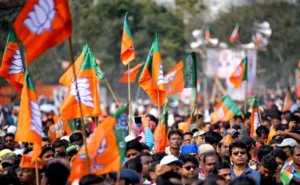
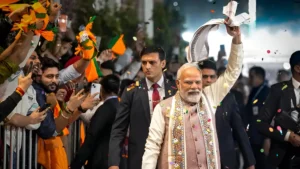
Image Source: BJP X There were two distinct messages from last month’s assembly elections in Bihar. The first centred on the remarkable ability of the Bharatiya Janata Party and, by implication, the National Democratic Alliance to overcome the reverses it suffered in the parliamentary election of 2024. There will inevitably be disagreements over what triggered the recovery: astute election management or economic populism. But what is sufficiently clear is that with a string of election victories, the BJP has been able to put an end to the speculation that the losses it suffered in the Lok Sabha poll were a pointer to a larger decline and the beginning of the end of the Narendra Modi era. Today, the political consensus is that the BJP has regained the initiative necessary for the prime minister to embark on major policy changes. The BJP also appears to have acquired the necessary self-confidence to resume its ambitious project to redraw the ideological underpinnings of Indian nationhood. The outcome of the next round of assembly elections, particularly in West Bengal and Assam, will determine whether the exercise is speeded up or will proceed at a cautious pace. Secondly, the past 18 months since the Lok Sabha election have been correspondingly dispiriting for the Opposition. It should be recalled that the Congress interpreted its success in winning 99 seats as a stupendous victory and evidence that it was on the cusp of a dramatic political recovery. With the INDIA combine trailing the NDA by a mere 1.9% of the popular vote, the earlier scepticism over the leadership of Rahul Gandhi was largely dispelled. The Congress expected to capitalise on the momentum of 2024 to regain control of Haryana, a state where the performance of the two-term BJP government had been lacklustre. It also hoped to repeat its Lok Sabha success in the Maharashtra assembly poll and cement the unlikely alliance with the Thackeray family-led Shiv Sena. Finally, since the Rashtriya Janata Dal-led Mahagathbandhan had come within a whisker of success in the 2020 Bihar assembly election, the reconquest of Patna seemed certain. None of these calculations passed the test of reality. Haryana was a surprising defeat, but the scale of the debacles in Maharashtra and Bihar was quite staggering and even unexpected. There was a small consolation prize in Jharkhand where the Congress was a junior partner of the Hemant Soren-led Jharkhand Mukti Morcha. Unfortunately for the party, there were no sweeteners in Delhi where it drew a blank. In the national capital that the party under the redoubtable Sheila Dikshit had governed uninterruptedly from 1998 to 2013, the Congress was relegated, once again, to a poor third position. Following the astonishingly poor performance in Bihar, a wave of demoralisation has gripped the Congress. Although the party stands a very good chance of ousting the Communist Party of India (Marxist)-led alliance in Kerala and benefiting from its alliance with Chief Minister M.K. Stalin in Tamil Nadu, pundits have already begun asking two questions. First, why has the Congress not succeeded in recovering ground in states such as Uttar Pradesh, Bihar, Odisha and West Bengal? In all these states, the anti-BJP space has been successfully captured by regional parties. In UP, the fortunes of the BJP rose dramatically in 1991 and then declined equally sharply in 1999. However, while the saffron party was able to regain its clout after 2014, the Congress decline seems to be more enduring. This is equally true of Odisha where the post-2009 Opposition space was hogged by the BJP, relegating the Congress to third place. It is worth noting that there was a Congress government in Bhubaneshwar until as late as 1999. A newcomer to politics such as Naveen Patnaik was able to regroup the political network of his late father, Biju Patnaik, in just two years between 1997 and 1999. Why has this proved impossible for the Congress in state after state? Secondly, despite acquiring a new fan club of Left-inclined activists ranging from the Aam Aadmi Party refugee, Yogendra Yadav, to the Communist Party of India (Marxist-Leninist) general-secretary, Dipankar Bhattacharya, the impression in traditional Congress circles is that Rahul Gandhi is not fit for the purpose. Arguably, this is a subjective perception that is disproportionately dependent on election outcomes. Rahul became a flavour of the season after his Bharat Jodo Yatra led to a minor Congress recovery in 2024. However, his ratings in the political circuit have dipped following the underwhelming response to his anti-Election Commission crusade. What concerns the shrinking band of loyal Congress networks is that the leader of the Opposition is fanatically single-minded about his latest pet themes that range from Rafale and Adani to vote-chori. Like his disastrous TV interview in 2014 where he seemed stuck with scripted assertions on women’s empowerment, Rahul seems to move from correctness to correctness, unmindful that in a country as diverse as India, a one-size-fits-all approach has its limitations. When was the last time Rahul made a considered intervention on concrete issues of governance, as opposed to holding forth on general themes such as democracy and the sanctity of the Constitution? Ever since he assumed charge of what some call his ‘family business’, Rahul has been berated for his sense of entitlement. This may seem unfounded to those who see him as a well-behaved gentleman, perhaps overdoing the casualness of attire but certainly not lacking in civility. The problem doesn’t lie in his distinctive personal style or even in his very un-Indian inclination for large doses of me-time; the arrogance comes through in his political approach that seems out of tune with contemporary realities. In leading the Opposition charge against the prime minister, what is unmistakable is Rahul’s baggage of visceral hatred. The Gandhi dynast doesn’t merely oppose Modi and the BJP, he loathes both with passionate intensity. In this, he mirrors the attitude of the small social circle around him and his sister. Comprising mainly of Congress inheritors, invariably those with a westernised orientation and American education, they Read More
Read More
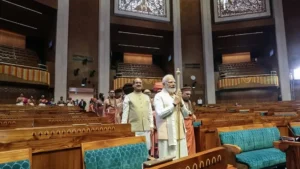
Image Source: Firstpost Some years ago, a perceptive British writer observed that his country was sharply polarised between the ‘somewhere’ people and those who could be dubbed the ‘anywhere’ people. In a curious sort of way, the clash between those who saw themselves as grounded in India’s distinctive nationhood and those whose sense of modernity stretched into multiculturalism and post-nationalism was evident during last week’s parliamentary discussion to commemorate 150 years of Vande Mataram. To those uneasy with the Modi government’s assertive nationalism, there was no earthly reason why valuable parliamentary time was expended on marking the landmark anniversary of the Constitution-decreed ‘national song’. Judging by their displeasure, a grand, possibly well-choreographed function in one of Delhi’s grand sarkari venues may well have sufficed. Judging by the somewhat supercilious intervention of Congress MP Priyanka Gandhi, the debate was occasioned by the Prime Minister’s waning confidence in his own governance and to divert attention from the more pressing problems confronting India. In all likelihood, those with Nehruvian mindsets would have considered exploring the fascinating by-lanes of the nationalist movement as of a priority than articulating the mismanagement of India’s largest airline. In the new history that has been dished out to generations of Indians since the Left takeover of education in the 1970s, Vande Mataram, while undeniably the most inspirational mantra of the freedom struggle, also carried Bankim Chandra Chatterjee’s more problematic baggage. The entire song, apart from being couched in difficult language, was also seen to be too full of Hindu imagery to be acceptable to Muslim and secular sensibilities. This mattered to Jawaharlal Nehru who, in the words of Nirad Chaudhuri, was “usually repelled by anything pronouncedly Hindu”. Although the trouble vexing the Congress during the second half of the 1930s was a nagging sense of a nation not yet fully defined by the Congress narrative, the compromise of adopting Vande Mataram as the ‘national song’ rather than the ‘national anthem’ was meant to be a solatium prize of nationalism without its sharper edges. The Constituent Assembly chairman’s ruling on January 24, 1950, like the Constitution’s embarrassing Directive Principles that called for cow protection, prohibited or allowed an uncomfortable civic choice: there was a quiet hope that in time Vande Mataram would steadily become decorative. This hasn’t happened, as evident from its popularity in flag-waving occasions. It is interesting that the BJP rather than the Congress has always taken the lead in trying to make Vande Mataram India’s parallel national anthem. The first initiative came from BJP MP Ram Naik who took the initiative in 1992 to ensure Vande Mataram was sung at the end of each parliamentary session. The suggestion was endorsed by PM P V Narasimha Rao whose personal attachment to the song overshadowed the objections. However, by trying to accommodate Jinnah’s objection to the ‘reliability’ of Vande Mataram, the Congress Working Committee resolution of 1935 failed to stem the tide of Muslim separatism. Eighty years later, Pakistan had become a reality. The lesson that BJP leadership drew from this controversy is that minority appeasement invariably leads to escalating demands and a corresponding emasculation of nationhood. The linkage between the partition of India and the ‘national song’ may not be scoffed at. Even if the full song is unlikely to be insisted upon and A R Rahman’s catchy version will continue to be mistaken for the real thing, the Vande Mataram debate is likely to be a landmark. The forthright speeches of the three top ministers of the government have indicated without a shred of doubt that the post-Independence squeamishness associated with the mantra Sri Aurobindo evocatively described as the “religion of patriotism” has been finally junked. Vande Mataram will remain a metaphor for national pride, just as it was 150 years ago. Courtesy: The Times of India
Read More
BJP System
Macaulay’s orphans
Image Source: BJP X There were two distinct messages from last month’s assembly elections in Bihar. The first centred on the remarkable ability of the Bharatiya Janata Party…
Indic Thought
150 years later, why the Vande Mataram debate is still relevant
Image Source: Firstpost Some years ago, a perceptive British writer observed that his country was sharply polarised between the ‘somewhere’ people and those who could be dubbed the…
Economic Reforms
New labour codes are a win-win for workers and employers
Image Source: Business Standard India’s labour market has been shaped by a complex legacy of well-intentioned but ultimately restrictive regulations. For decades, labour laws designed to protect…

Publications
Lorem ipsum dolor sit amet, consectetur adipiscing elit. Ut elit tellus, luctus nec ullamcorper mattis, pulvinar dapibus leo.
Read More

Events
Lorem ipsum dolor sit amet, consectetur adipiscing elit. Ut elit tellus, luctus nec ullamcorper mattis, pulvinar dapibus leo.
Read More

Podcasts & Talks
Lorem ipsum dolor sit amet, consectetur adipiscing elit. Ut elit tellus, luctus nec ullamcorper mattis, pulvinar dapibus leo.
Read More